
E20 / E40 / E60 · Proposed fuel development
Ethanol Blending
Proposed second-generation bioethanol production and E20 / E40 / E60 road-fuel blending programmes, with a possible supply relationship to the separate SAF division.

One of ten principal business divisions
Public status · 5 Oct 2026
ProposedThe 50,000-tonnes/year figure is planned bioethanol output, not an operating capacity or SAF output. Corporate information
Second-generation bioethanol project
Planned ethanol production capacity · not SAF
From biomass to fuel
The Ethanol Blending division brings together proposed ethanol production and E20 / E40 / E60 road-fuel blending programmes. Sustainable Aviation Fuel (SAF) is a separate division. Producing fuel-grade ethanol is distinct from blending it with petrol, and aviation fuel requires further conversion and refining. These are proposed development pathways, not a statement of current fuel availability.
E20 / E40 / E60
The E-number describes the proportion of ethanol in a petrol blend by volume. Each programme must follow applicable fuel specifications and approved vehicle or engine compatibility; higher blends are not suitable for every vehicle.
- E20 — 20% ethanol and 80% petrol by volume
- E40 — 40% ethanol and 60% petrol by volume
- E60 — 60% ethanol and 40% petrol by volume
- Fuel use — confirm applicable standards and manufacturer-approved compatibility before use
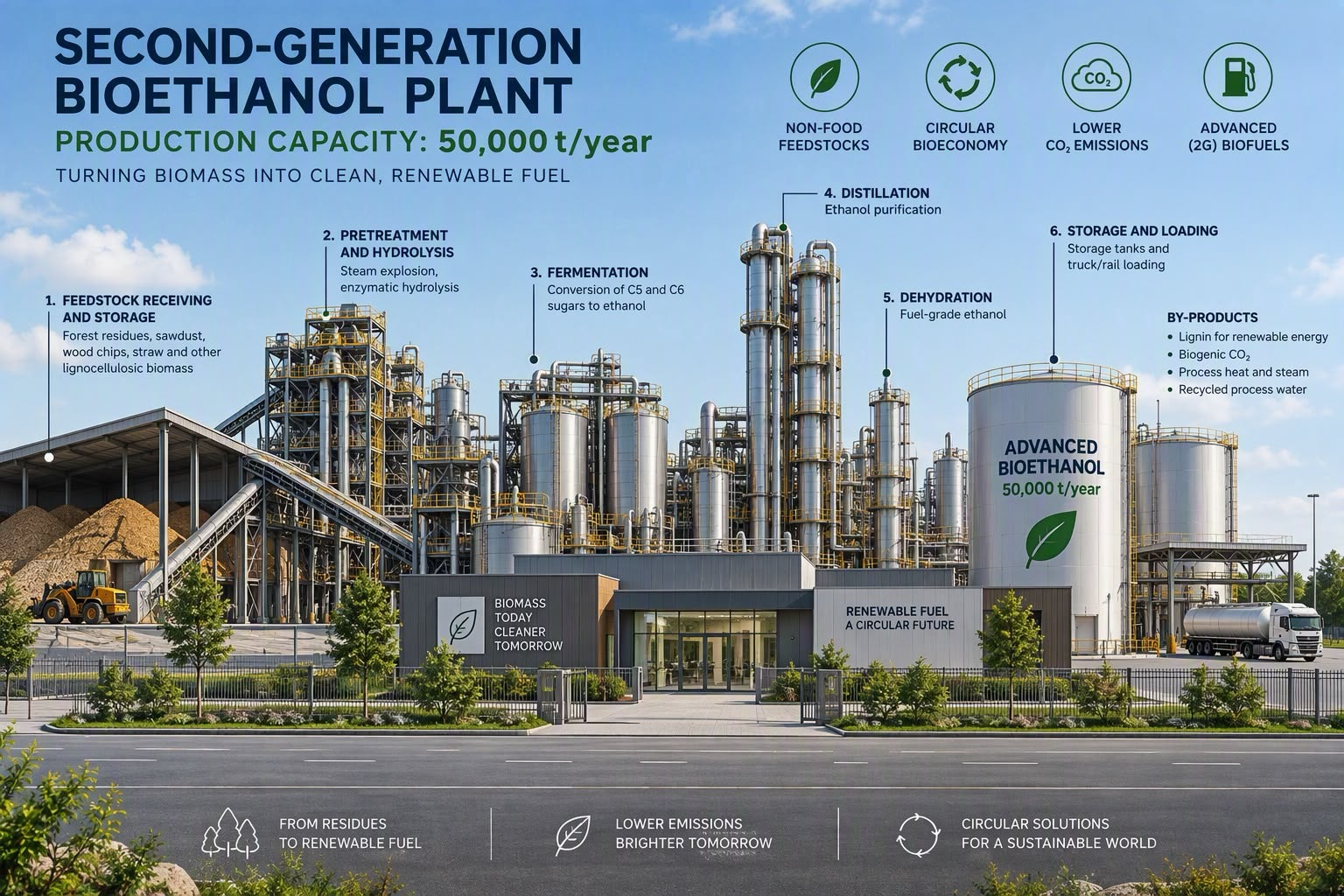
Proposed second-generation plant
The proposed bioethanol plant has a planned production capacity of 50,000 tonnes per year. Second-generation production uses non-food lignocellulosic biomass, such as forest residues, sawdust, wood chips and straw. The supplied illustration communicates the proposed process; final feedstock selection, engineering, site arrangements, approvals and commercial terms remain project-dependent. This capacity is ethanol output, not SAF output.
Feedstocks and production
The illustrated six-stage sequence converts biomass into fuel-grade ethanol. Petrol blending is a separate downstream operation.
- 01 · Receiving and storage — collect and prepare suitable non-food biomass
- 02 · Pretreatment and hydrolysis — release fermentable sugars using processes such as steam explosion and enzymatic hydrolysis
- 03 · Fermentation — convert C5 and C6 sugars into ethanol
- 04 · Distillation — separate and purify the ethanol
- 05 · Dehydration — remove remaining water to achieve the required fuel-grade specification
- 06 · Storage and loading — store finished ethanol and prepare controlled dispatch
Circular outputs
The proposed design considers recovery and reuse alongside fuel production. Actual arrangements and environmental performance depend on feedstock, technology and final plant design; no quantified emissions reduction is claimed.
- Lignin — potential energy recovery from residual biomass
- Biogenic CO₂ — potential recovery from fermentation, subject to quality and end-use requirements
- Process heat and steam — opportunities for energy integration
- Process water — treatment and recycling within the proposed system
Related SAF development
Sustainable Aviation Fuel is a separate JBE division exploring a downstream alcohol-to-jet pathway. Our proposed ethanol plant could supply an intermediate, but ethanol is not jet fuel and the plant’s capacity must not be treated as SAF output.
Project enquiries
JBE welcomes exploratory discussions about feedstock, engineering, investment, blending programmes and potential offtake. Technical scope, approvals and commercial commitments are established for each project.
Continue exploring
Corporate enquiries